After a summer spent in lighter clothing, on holiday or simply outdoors more often, it…
Beyond the Beach: Why September is the Smartest Time to Start Your Body Contouring Journey
Body contouring does not have to begin with a last-minute rush before a summer holiday. In fact, September can be one of the most useful times to start thinking about the changes you would like to make, particularly when you have the time to approach treatment gradually and properly.
After summer, many people return to more consistent routines around exercise, nutrition and general wellbeing. It can also be a good opportunity to focus on areas that have remained resistant despite those efforts, whether that is a pocket of fat around the abdomen, reduced muscle definition or skin that no longer feels as firm as it once did.
Non-surgical body contouring can target each of these concerns, but the right treatment depends on what is creating the shape you see. Results also develop over time, so starting in September allows treatments to be planned, completed and reviewed without working towards an unrealistic last-minute deadline.
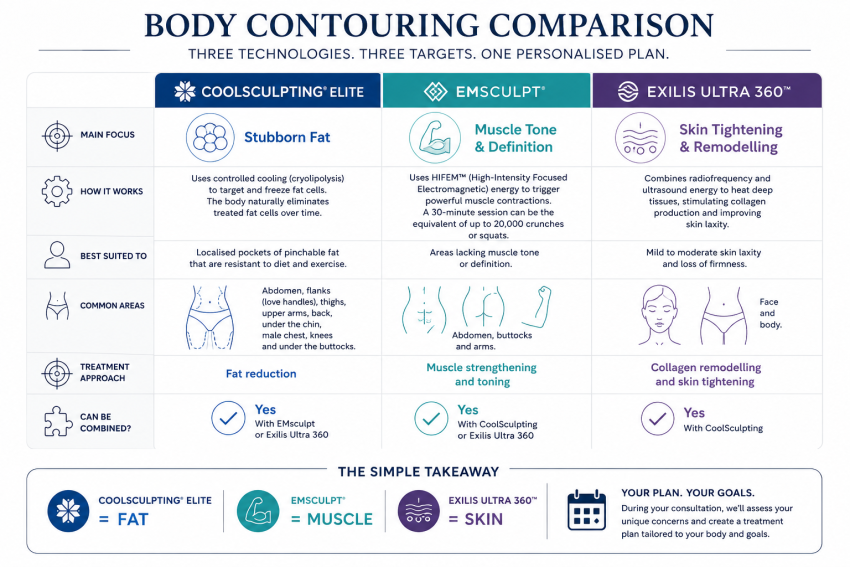
At Cambridge Laser Clinic, we approach body contouring by looking at three key components: fat, muscle and skin. One patient may have pinchable abdominal fat despite maintaining a stable weight. Another may benefit more from improving underlying muscle tone, while someone else may primarily be concerned about skin laxity.
Often, there is more than one factor involved. Identifying which layers need attention allows treatment to be much more targeted and gives you a clearer, more realistic route towards improving your body shape.
What Is Body Contouring?
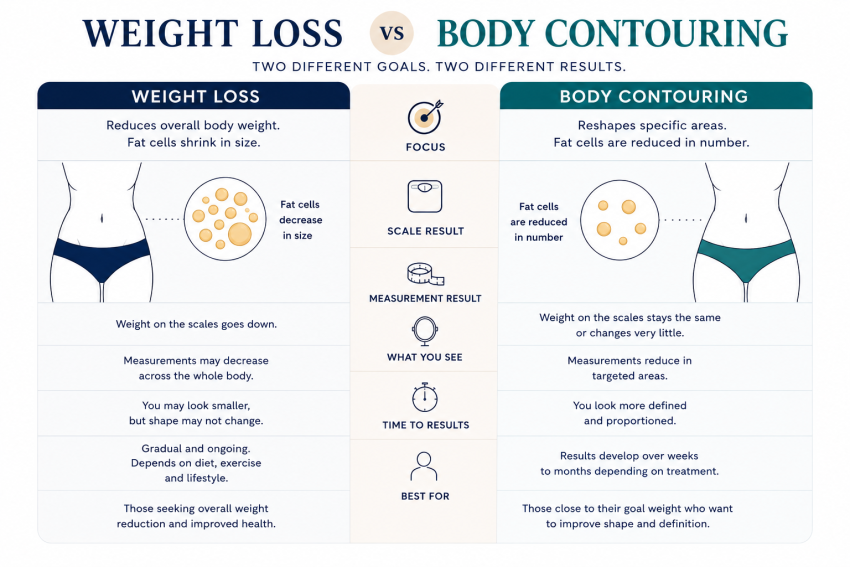
One of the most important things to understand is that body contouring is not the same as weight loss. When you lose weight, existing fat cells generally become smaller. The change happens more broadly across the body, although where you lose fat first is largely outside your control.
Body contouring is much more targeted. It may be appropriate when your overall weight is relatively stable but a particular area remains out of proportion with the rest of your body. Common examples include a persistent lower abdominal pocket, love handles or fat underneath the buttocks.
But fat is only part of the picture. When we assess a body contour, we need to consider:
- Fat: Is there a distinct pocket of pinchable subcutaneous fat?
- Muscle: Is reduced muscle tone contributing to a softer contour?
- Skin: Is laxity preventing the area from looking as firm as you would like?
Sometimes one layer is clearly responsible. Quite often, particularly around the abdomen, there is more than one factor involved.
That is why two people asking for a “flatter stomach” may be advised very differently.
Which Body Contouring Treatment Is Best for Stubborn Fat?
If you maintain a relatively stable weight but still have a specific area that does not respond to diet and exercise, the issue may be localised subcutaneous fat.
This is the softer, pinchable fat that sits beneath the skin. It is different from visceral fat, which lies deeper within the abdomen around the internal organs. This distinction matters because CoolSculpting ELITE is designed to target suitable pockets of subcutaneous fat, not visceral fat or overall body weight.
CoolSculpting ELITE uses cryolipolysis, or controlled cooling. Fat cells are particularly sensitive to cold, so the treatment can damage cells within the targeted fatty layer. The body then gradually processes and clears the affected cells.
This is why CoolSculpting is a body contouring treatment rather than a weight-loss treatment. The aim is to improve the proportions of a particular area rather than make the whole body smaller.
Areas that may be treated include:
- abdomen and flanks
- upper arms and back
- inner and outer thighs
- underneath the buttocks
- underneath the chin
- male chest
- around the knees
Treatment planning also considers how fat is distributed. Abdominal fullness, for example, may sit across the lower stomach, centrally or extend around the flanks. CoolSculpting ELITE has different applicators for different anatomical areas, and several placements may sometimes be needed to create a balanced contour.
At Cambridge Laser Clinic, we would also consider the skin overlying the fat and the muscle underneath it. If several layers are contributing to the concern, reducing fat alone may not provide the most complete improvement.
How Long Does CoolSculpting ELITE Take to Work?
CoolSculpting starts a biological process rather than producing an immediate reduction. After treatment, the affected fat cells are gradually processed by the body. Cambridge Laser Clinic advises that results can continue to develop over approximately three to six months.
This is one reason September can be a useful time to begin. There is time for the result to develop and be reviewed without trying to meet a last-minute holiday or event deadline.
Progress may be assessed at around six weeks and again at approximately 12 weeks. For some patients, the initial treatment plan provides sufficient improvement. Others may benefit from further treatment if a residual pocket of fat remains. The key is to allow enough time to assess the developing contour before deciding whether another session is appropriate.
Can EMsculpt Help If Fat Is Not the Main Problem?
A softer-looking abdomen does not necessarily mean there is too much fat. Underlying muscle tone also influences body shape and definition.
EMsculpt uses High-Intensity Focused Electromagnetic energy, or HIFEM, to stimulate powerful involuntary muscle contractions. These supramaximal contractions occur at an intensity that cannot be voluntarily sustained through conventional exercise.
Cambridge Laser Clinic describes a 30-minute session as producing the equivalent of approximately 20,000 crunches, squats, curls or leg extensions, depending on the area being treated.
EMsculpt can be used on areas including the abdomen, buttocks and arms, but the objective varies according to the anatomy. For the abdomen, improving the underlying muscles can create greater tone and definition. If a substantial layer of subcutaneous fat covers those muscles, however, muscle treatment alone may not create the visible change someone wants.
The buttocks are different. Fat contributes to their shape and volume, so reducing it may not be desirable. Strengthening the underlying gluteal muscles while preserving volume may make more sense. This is why body contouring should not automatically mean fat reduction. Sometimes improving the structure underneath the fat and skin is the more appropriate route.
What If Loose Skin Is Affecting My Body Shape?
Sometimes fat and muscle are not the main problem. Skin laxity can soften an otherwise well-defined contour. Collagen provides important structural support within the skin, but its quality and quantity change with age. Pregnancy and weight fluctuations can also leave the skin less able to conform closely to the tissues underneath it.
Where skin quality is contributing to the concern, Exilis Ultra 360 may be considered. Exilis Ultra 360 combines radiofrequency and ultrasound energy to heat targeted tissue in a controlled way. This thermal effect stimulates a response that includes collagen remodelling, with improvements developing gradually rather than appearing immediately.
The technology can also be adjusted according to the treatment objective. Where laxity is the main concern, treatment can focus on tightening and firmness. Cambridge Laser Clinic also describes a “Hot Sculpting” approach where skin tightening is combined with targeted fat treatment.
This flexibility is useful because patients do not always fit neatly into one category. Someone may have very little unwanted fat but mild skin laxity obscuring their definition. Another patient may have both a localised fatty layer and looser overlying skin.
For milder concerns, we would usually focus on the tissue making the greatest contribution. Where fat, muscle and skin are all involved, a staged or combination approach may be more appropriate.
Ultimately, choosing a body contouring treatment is less about asking which machine is best and more about identifying what is creating the contour in the first place.
Who Is a Good Candidate for Non-Surgical Body Contouring?
The best candidates are usually people looking for refinement rather than major weight reduction. You may be suitable if you are at or reasonably close to a weight you are comfortable maintaining, but have a particular area that remains resistant to diet and exercise.
A consultation is especially useful if you find yourself saying something such as, “I exercise regularly, but this one area never changes.” That does not automatically mean CoolSculpting is the answer. The area still needs to be examined. If the concern is caused mainly by lax skin or reduced muscle tone, another approach may produce a more appropriate result. In more complex cases, treatment may need to address several layers in sequence.
Body contouring also has limits. Where there is substantial excess fat, significant skin excess or another issue that cannot realistically be corrected using non-invasive technology, it is important that this is identified rather than promising a result the treatment cannot deliver.
Frequently Asked Questions About Body Contouring
Will body contouring change the number on the scales?
Not necessarily. Body contouring is designed primarily to alter the shape or definition of a selected area rather than produce significant overall weight loss. Changes may therefore be much more apparent in photographs, clothing fit and body proportions than on the scales.
Do I need to reach my exact goal weight before treatment?
Not necessarily, but a relatively stable weight is helpful. Significant weight changes after treatment can alter your proportions and make the eventual contour more difficult to predict. Your practitioner can advise whether it makes sense to treat now or wait until your weight is more stable.
Can men have body contouring treatments?
Yes. The suitability of treatment depends on anatomy and the concern being treated rather than gender. For example, CoolSculpting ELITE can be used for areas including the abdomen, flanks and male chest, while EMsculpt may be considered where greater muscle definition is the objective.
Can I exercise while having body contouring treatments?
This depends on the treatment and how you feel afterwards. Non-invasive treatments are designed to involve minimal interruption to normal routines, but you should follow the specific aftercare advice given for your procedure rather than planning exercise around general online guidance.
What happens if my body changes after treatment?
Pregnancy, ageing, hormonal changes, weight fluctuations and changes in activity levels can all affect body shape over time. Previous body contouring does not prevent these natural changes, which is another reason maintaining realistic expectations and a stable lifestyle is important.
Is body contouring suitable after losing a lot of weight?
It depends on what remains after the weight loss. A small localised fat deposit, reduced muscle tone and significant loose skin are very different concerns. After substantial weight loss, excess skin may sometimes be too advanced for a non-invasive tightening treatment to achieve the degree of change someone wants, so an individual assessment is particularly important.
Considering Body Contouring in Cambridge This Autumn?
If summer has highlighted an area you would like to change, September is a good time to find out what is really contributing to it rather than immediately choosing a treatment.
At Cambridge Laser Clinic, body contouring plans can be built around the different components of your concern, whether that means reducing a localised pocket of fat with CoolSculpting ELITE, improving muscle tone with EMsculpt, addressing skin laxity with Exilis Ultra 360, or combining approaches where there is a clear clinical reason to do so.
If you are based in Cambridge or the surrounding areas and are considering non-surgical body contouring, book a consultation to have the area assessed and discuss which approach is appropriate for your body, your goals and your timescale.
Related Posts