Body contouring does not have to begin with a last-minute rush before a summer holiday…
The September Skin Reset: Why Autumn Is the Start of “Laser Season” for Resurfacing and Scar Removal
September is often when changes in the skin become easier to notice.
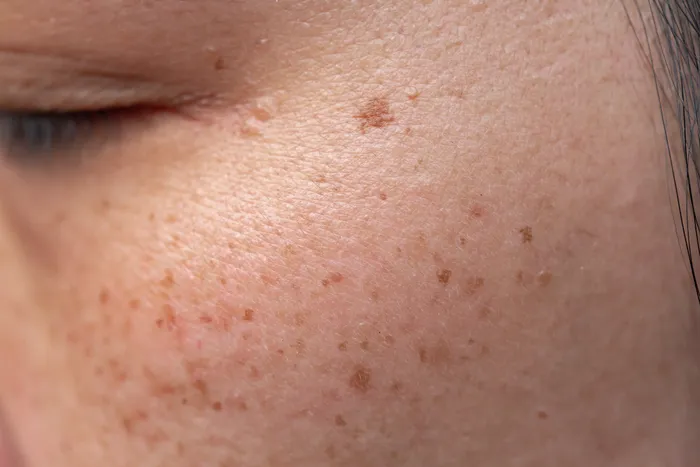
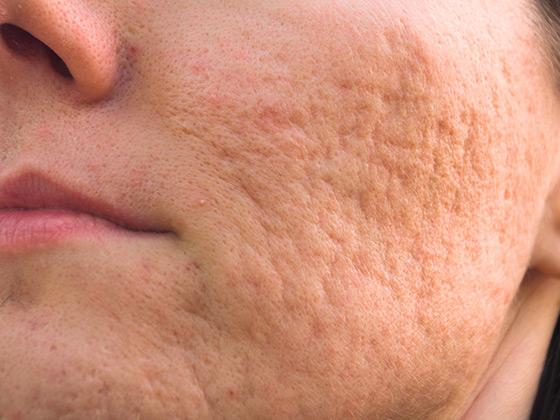
As a summer tan fades, areas of pigmentation may stand out more clearly. Skin can look rougher or less even, while old acne scars may become more noticeable, particularly when the light catches the skin from different angles.
It is also a useful time to start thinking about laser treatment. At Cambridge Laser Clinic, autumn is an important part of the year for skin resurfacing, especially for patients looking to improve acne scarring, uneven texture, sun damage and areas of pigmentation. Lasers do not suddenly become more effective when summer ends, but lower levels of sun exposure can make it easier to plan treatment and protect the skin afterwards.
If resurfacing is something you have been considering, September can therefore be a good time to have your skin assessed and understand what type of treatment, if any, would be appropriate.
Why Is Autumn a Good Time for Laser Skin Resurfacing?
Laser resurfacing works by creating a very precise, controlled treatment within the skin. This removes selected areas of damaged skin and encourages the body to begin its natural repair process.
As the skin heals, new skin cells develop and collagen is produced and remodelled. This gradual renewal is what can help improve the appearance of uneven texture, lines and certain types of scarring.
The healing skin does, however, need to be protected from excessive UV exposure. Too much sun following laser treatment can affect recovery and increase the risk of unwanted changes in pigmentation.
Sun protection is essential throughout the year, but autumn can make this easier. There are fewer hours of strong sunlight, and most patients are spending less time sunbathing or travelling to very sunny destinations.
There is also more time to take a measured approach. Scar treatment, in particular, may involve several stages rather than one appointment. Starting in autumn gives us the cooler months ahead to assess the skin, treat it where appropriate and allow enough time for healing between procedures.
How Does Laser Skin Resurfacing Work?
Skin resurfacing essentially encourages the skin to replace damaged tissue with healthier new tissue. At Cambridge Laser Clinic, we use ablative lasers for resurfacing. These lasers are attracted to the water naturally present in the skin. This allows us to remove extremely precise amounts of tissue while controlling how deeply we treat.
There are two main approaches. With traditional laser resurfacing, the whole surface of the selected area is treated. Because more skin is resurfaced, this can produce a more intensive effect but also involves a longer recovery. Fractional laser resurfacing treats tiny sections of the skin while leaving small areas of untreated skin between them. These untreated areas help the skin heal more quickly.
Whichever approach is selected, resurfacing is not simply about removing the top layer of skin. The treatment also encourages collagen remodelling beneath the surface. Over the following weeks and months, this can help the skin become smoother and make some scars less obvious.
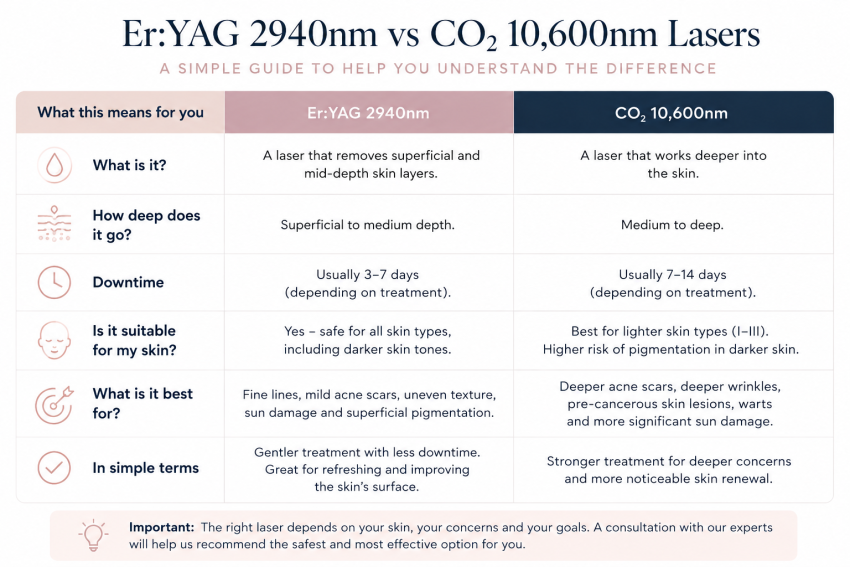
At Cambridge Laser Clinic, we use Er 2940nm and CO₂ 10,600nm lasers for different levels of resurfacing.
What Is the Difference Between Er 2940nm and CO₂ 10,600nm Lasers?
Both lasers are used for skin resurfacing, but at different depths. Er 2940nm is generally suited to more superficial concerns, while CO₂ 10,600nm can treat deeper textural changes and more established scarring.
Can Laser Treatment Remove Acne Scars?
Patients often search for acne scar removal, but it is helpful to be realistic about what this means.
Once the skin has developed a true scar, treatment is generally about improving it rather than completely removing every trace of it. The aim may be to soften its edges, reduce its depth, improve the surrounding texture or make differences in colour less noticeable.
There is another reason we avoid treating every acne scar in exactly the same way: acne scars come in different forms.
At Cambridge Laser Clinic, we often see more than one scar type on the same face. Identifying those differences is an important part of deciding what treatment is likely to help.
For example:
- Boxcar scars are wider depressions with more defined edges. Er 2940nm or CO₂ 10,600nm resurfacing may be considered.
- Rolling scars create broader dips and an uneven or wave-like texture. Laser resurfacing may also be useful for these.
- Ice-pick scars are very narrow but extend more deeply into the skin. TCA CROSS offers a more targeted way of treating these individual scars.
- Tethered or anchored scars are held down by bands of tissue beneath the skin. Surgical subcision can be used to release those attachments.
- Atrophic scars involve a loss of tissue and volume. In selected cases, fat grafting or dermal fillers may be considered.
- Flat red marks following acne, sometimes called post-inflammatory erythema or PIE, are different from depressed scars and may be treated with the V Beam 595nm PDL laser.
- Flat brown marks following acne, known as post-inflammatory hyperpigmentation or PIH, may require pigment-focused treatment such as Q-switched Ruby 694nm, KTP 532nm or Nd 1064nm lasers.
This is why effective acne scar treatment starts by examining the skin rather than simply choosing a laser.
Why Might I Need More Than One Treatment for Acne Scarring?
Acne rarely leaves behind one perfectly uniform type of scar. Someone may have several narrow ice-pick scars around the cheeks, wider boxcar scars nearby and areas where the skin is being pulled down by deeper attachments. Using one treatment over the entire area would not address each of those problems equally well.
A staged approach can make more sense. For example, deeper ice-pick scars might first be treated individually with TCA CROSS. Tethered scars may need to be released using subcision. Once those deeper structural problems have been addressed, laser skin resurfacing may then be used to improve the broader texture of the skin.
This does not mean that every patient needs several different procedures. For someone with relatively straightforward, superficial scarring, laser resurfacing alone may be appropriate.
The benefit of assessing the scars individually is that we can avoid unnecessary treatment while concentrating on the areas most likely to respond.
It is also why we examine scars under different lighting. Angled light can reveal shallow depressions and tethering that may be difficult to see when looking directly at the face.
Should I Book Laser Resurfacing as Soon as Summer Ends?
September may mark the beginning of laser season, but there is no need to rush into treatment. If your skin is still tanned, you have recently had significant sun exposure or you have another reason why the skin needs more time to settle, waiting may be safer.
The age of a scar matters too. Scars continue to change after the original injury has healed. The skin can take many months to mature, and Cambridge Laser Clinic notes that this process may continue for up to 18 months. In some cases, the most appropriate recommendation is therefore to allow more healing time before treating the scar.
Think of September as the beginning of a useful assessment and treatment window, rather than a deadline. A consultation allows us to establish what type of scar or skin concern you have, whether laser resurfacing is appropriate and how deeply the skin would need to be treated. If another scar treatment would be more useful first, this can also be incorporated into the plan.
FAQs About Laser Resurfacing and Scar Treatment
Can old acne scars still be treated?
Yes. Scars do not necessarily become unsuitable for treatment simply because they have been present for several years. What matters more is the type of scar, how deep it is, the condition of the surrounding skin and what degree of improvement is realistically achievable.
Can laser resurfacing be used somewhere other than the face?
Potentially, yes. Scars can occur on many areas of the body. However, skin thickness and healing vary between different areas, so treatment settings and suitability need to be considered individually.
Will I need a laser test patch?
A test patch may be recommended depending on the laser treatment, your skin type and the concern being treated. This gives the practitioner an opportunity to see how your skin responds before treating a larger area.
How long before an important event should I have laser resurfacing?
This depends on how deeply the skin is treated. Redness, swelling, peeling and some residual pinkness can occur during recovery, particularly following more intensive resurfacing. If you have a wedding, holiday or other important event planned, mention it during your consultation so treatment can be timed appropriately.
Can I wear make-up after laser resurfacing?
You will need to wait until the skin has healed sufficiently before applying make-up. The timing varies according to the depth and type of treatment, so you will be given individual aftercare advice rather than a single rule that applies to every patient.
Considering Laser Treatment in Cambridge This Autumn?
If acne scars, uneven texture or an older scar have become more noticeable, autumn can be a useful time to find out what is causing the irregularity and whether treatment is appropriate.
At Cambridge Laser Clinic, we assess the type, depth and condition of the scar or skin concern before recommending treatment. Depending on what we find, this may involve Er 2940nm or CO₂ 10,600nm laser skin resurfacing, another form of scar treatment, or a carefully planned combination of approaches.
If you are considering laser treatment, skin resurfacing or scar removal in Cambridge, you can book a consultation to have your skin assessed and discuss the options that are appropriate for you.
Related Posts