The September Skin Reset: Why Autumn Is the Start of “Laser Season” for Resurfacing and Scar Removal
September is often when changes in the skin become easier to notice. As a summer…

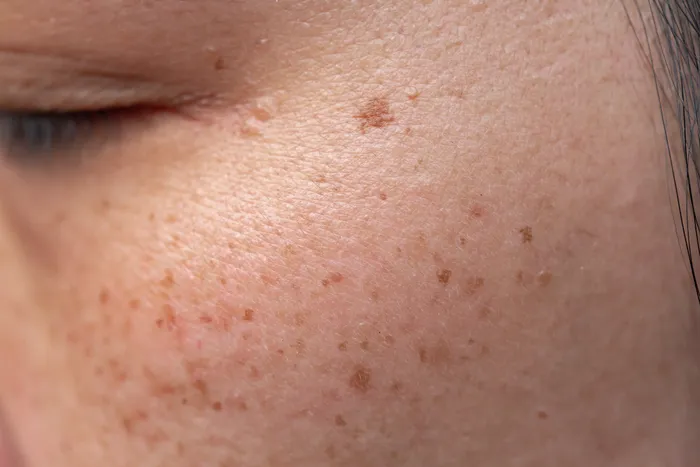
You come back from holiday with a tan, your skin looks brighter and then, a few weeks later, the brown marks start to show.
A sunspot on your cheek looks darker. Freckles that were barely noticeable in spring suddenly stand out. You may also notice more uneven pigmentation across your forehead, décolletage or the backs of your hands.
This is something we commonly see at Cambridge Laser Clinic towards the end of summer. It can feel as though the pigmentation has suddenly appeared, but often the holiday has simply made existing sun damage more visible.
Certain types of pigmentation can respond very well to laser treatment, but the first step is establishing exactly what the pigmentation is. A straightforward sunspot and melasma may both look like brown marks, but they behave very differently and should not automatically be treated in the same way.
When your skin is exposed to ultraviolet light, pigment-producing cells called melanocytes increase their production of melanin. This is part of the skin’s natural response to UV exposure and is what creates a tan.
Over time, however, pigment can become concentrated in particular areas. These flat brown marks are commonly called sunspots, or solar lentigines, and frequently appear on areas with the greatest cumulative sun exposure, including the face, décolletage, shoulders, forearms and backs of the hands.
A sunny holiday can make existing pigmentation significantly darker. It is worth remembering that the sunspot you notice after two weeks away probably was not created entirely during those two weeks. Sunspots are usually associated with cumulative UV exposure, so what you are seeing may reflect many previous summers.
Pigmentation can also become more noticeable as your surrounding tan fades, leaving individual brown marks standing out more clearly.
Not necessarily. Brown pigmentation can have several different causes, and identifying what you are looking at is important before considering treatment.
Common types include:
This is why we do not treat every brown mark as something that can simply be “lasered off”.
At Cambridge Laser Clinic, pigmented lesions are assessed by a doctor before laser treatment. This helps establish what the pigmentation is, whether laser treatment is appropriate and whether a lesion requires further medical investigation rather than cosmetic treatment.
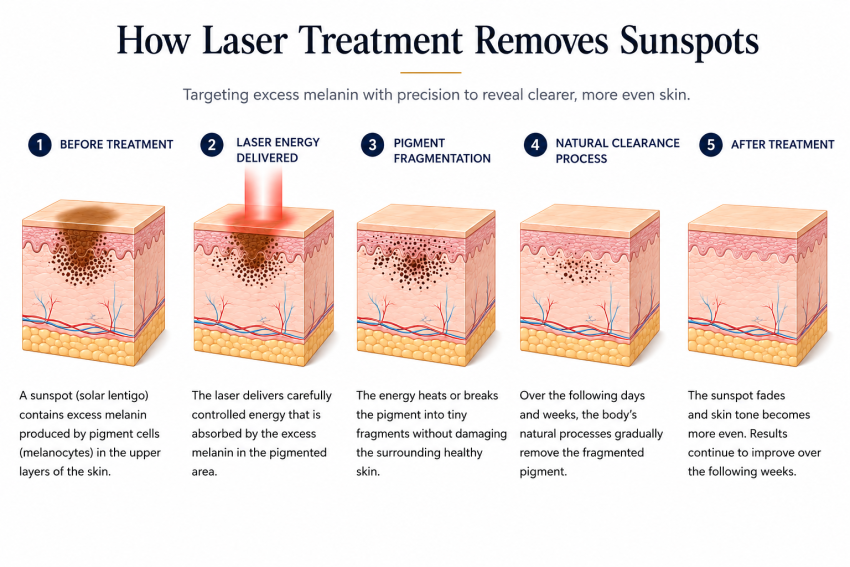
Laser treatment works by delivering carefully controlled energy that is absorbed by excess melanin, helping to break down the concentrated pigment while minimising damage to the surrounding skin. The fragmented pigment is then gradually cleared by the body over the following days and weeks.
There is no single laser that is best for every type of pigmentation. At Cambridge Laser Clinic, we have a range of laser and light technologies available, which means treatment can be chosen according to your skin and the type of pigmentation rather than relying on one device for everyone.
Depending on what we find during your assessment, options may include:
For a handful of clearly defined sunspots, a targeted treatment may be all that is needed. If pigmentation is more widespread or appears alongside other changes in the skin, we may recommend a different approach.
The important thing is not the name of the laser. It is choosing the right treatment for the type of pigmentation, your skin type and what you actually want to improve.
It can, which is why careful assessment matters. One possible complication is post-inflammatory hyperpigmentation, where the inflammation created by treatment stimulates additional pigment production. Hypopigmentation, where the skin becomes lighter, can also occur.
Skin type therefore plays an important role in treatment planning. Darker skin naturally contains more melanin in the surrounding tissue, which needs to be considered when choosing wavelengths and treatment settings. A recent tan also increases the amount of melanin within the skin, which is one reason treatment may need to be postponed after a holiday.
Pigmentation lasers are not simply a case of increasing the energy until the brown spot disappears. Appropriate diagnosis, technology and settings all matter.
Melasma needs a different approach. Unlike an isolated sunspot, melasma is a more complex pigmentation condition influenced by factors including UV exposure and hormones. It also has a tendency to recur. Aggressively treating the visible pigment can sometimes make melasma worse rather than better.
For milder or more diffuse cases, we would usually look first at sun protection, skincare and pigment control. Cambridge Laser Clinic offers Obagi Systems, which may form part of a medically guided skincare programme where appropriate. Chemical peels may also be considered for selected patients. Laser treatment can have a role in certain cases, but it needs to be approached cautiously.
The aim with melasma is generally long-term control rather than promising that the pigmentation can be permanently removed.
Years of UV exposure can also leave the skin with uneven tone, rougher texture and fine lines. If you have several clearly defined sunspots, targeted pigment laser treatment may be enough. Where pigmentation is more widespread, Obagi Systems or chemical peels may be incorporated into the treatment plan where appropriate.
For more advanced photodamage, where pigmentation appears alongside significant textural changes or fine lines, laser skin resurfacing may sometimes be considered. This is a broader treatment with different recovery requirements and risks, so it would not be recommended simply because someone has a few sunspots.
More treatment does not necessarily mean better treatment. The aim is to use the least intensive approach capable of addressing the concerns safely and effectively.
Laser can target existing pigmentation, but it cannot prevent your skin from producing pigment in the future. Even when an individual sunspot responds very well, new areas of pigmentation can develop with further UV exposure.
This makes broad-spectrum sun protection an important part of both treatment and prevention. And it is not just your face. The neck, chest and backs of the hands accumulate significant UV exposure and are common places for sunspots to become increasingly noticeable over time.
Autumn can be a practical time to start looking at post-summer pigmentation. Strong summer sun is reducing, holidays are often over and keeping treated skin protected from UV exposure becomes easier.
However, if you still have a tan, we may recommend waiting. Increased melanin within the surrounding skin can affect how laser energy is absorbed and increase the risk of unwanted pigment changes.
Waiting also allows temporary summer pigmentation to settle. Freckles may fade considerably as UV exposure reduces, whereas established solar lentigines are more likely to remain. By assessing the skin once your tan has faded, we can get a much clearer idea of what actually needs treating.
There is no universal waiting period because it depends on how much you have tanned and your individual skin. Your practitioner can assess when your skin is ready to be treated safely.
Yes, appropriate pigmentation on the backs of the hands can be treated. The hands are one of the areas where cumulative sun exposure commonly becomes visible.
It can. Fake tan changes the colour of the skin surface and may interfere with assessment or treatment. You will normally be given instructions about when to stop using tanning products.
Active skincare may need to be temporarily adjusted around laser treatment. Follow the specific aftercare advice provided by your practitioner rather than immediately restarting stronger products.
A test patch may be recommended depending on your skin type, pigmentation and the laser being considered. It can help assess how your skin responds before a larger area is treated.
If your tan has faded but the brown marks have stayed behind, the next step is finding out exactly what they are.
At Cambridge Laser Clinic, we assess the type of pigmentation, your skin type and the extent of sun damage before recommending treatment. For some patients, targeted laser treatment for individual sunspots may be appropriate. For others, skincare, chemical peels or a broader treatment plan may make more sense.
If you are based in Cambridge or the surrounding areas, you can book a consultation with Cambridge Laser Clinic to have your pigmentation assessed and discuss the most appropriate next step.